

Unmasking the Lazarus Group: North Korea’s Cyber Warfare Strategy
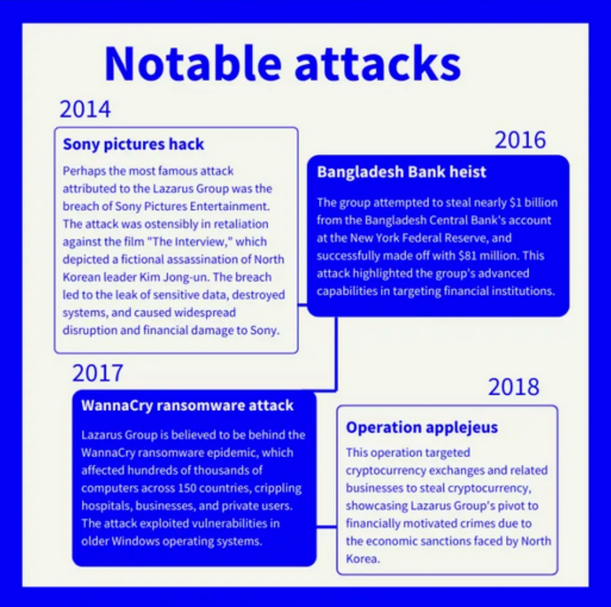
Introducing the Lazarus Group, a shadowy cybercriminal collective, also known as Hidden Cobra, believed to be under the aegis of North Korea. Since emerging in 2009, this group has gained notoriety for orchestrating some of the most advanced and destructive cyberattacks, targeting espionage, sabotage, and financial theft. Their high-profile operations, from data breaches to major financial heists, illustrate their extensive capabilities and global reach.
Evolution of a Cyber Menace
The Lazarus Group, widely suspected to be linked with North Korea’s intelligence and cyber warfare sectors, has evolved significantly over the years. Initially focused on gathering sensitive information—characteristic of Advanced Persistent Threats (APTs)—their operations have progressively shifted towards financial exploitation. By executing sophisticated attacks on banking and cryptocurrency systems, they have developed intricate “virtual” heists. This shift likely stems from the North Korean regime’s need to bypass global sanctions and secure foreign currency. Their transition from espionage to financial crime underscores their adaptability and relentless pursuit of monetary gain.
Tactical Innovations and Evolving Techniques
Lazarus Group remains at the forefront of cyber threats by continually refining their techniques. They exploit zero-day vulnerabilities—previously undisclosed software flaws that can be leveraged for unauthorized access or damage. These vulnerabilities, prized on the black market, enable targeted attacks with minimal detection risk and high success rates.
The group has increasingly targeted individuals with fraudulent job offers, particularly in tech and cryptocurrency sectors. This approach not only facilitates the theft of valuable digital assets but also provides potential insider access to tech firms and crypto exchanges, enhancing their espionage and theft capabilities.
Recent tactics include targeting freelance developers working on NFTs and cryptocurrency wallets. Utilizing platforms like “freelancer.com,” they distribute malicious JavaScript and exploit repositories on GitHub and Google Cloud. By posing as potential employers or interviewers, they lure victims and compromise their systems.
Global Consequences and Defensive Measures
The Lazarus Group’s activities have profound implications for global cybersecurity and economic stability. Their actions highlight the capabilities of state-sponsored actors to disrupt and steal, emphasizing the need for robust cybersecurity measures across all sectors—governmental and personal alike.
To combat these advanced threats, understanding groups like Lazarus is crucial for developing effective defenses. Security firms, such as those affiliated with Gen, play a vital role in detecting and neutralizing zero-day exploits and other attack vectors. This mitigates the threat landscape, making high-level attacks more challenging and costly for adversaries.
Navigating the Cybersecurity Challenge
Defending against nation-state actors like Lazarus is particularly challenging due to their state support, substantial resources, and advanced skillsets. Effective defense strategies involve continuous technological advancements, collaborative threat intelligence sharing, and stringent cybersecurity practices.
International cooperation is essential in countering APTs. Cross-border intelligence sharing among private cybersecurity entities can strengthen collective defenses and provide broader protection against sophisticated threats.
Preparing for the Future
As cyber tactics evolve, so will the strategies employed by the Lazarus Group. Anticipating and preparing for increasingly sophisticated and covert methods is critical for staying ahead of these threats. By understanding Lazarus Group’s tactics and enhancing our defenses, we can better protect our digital infrastructure from these formidable adversaries.
Both organizations and individuals must remain vigilant, informed, and prepared to confront these advanced threats. International collaboration and proactive security measures will be our best defense in the ongoing battle to secure our interconnected digital world.


